Synoptic diagram of the inter-disciplinary approach
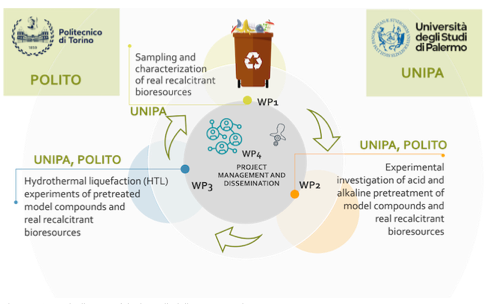
The project is based on the cooperation of complementary research units with consolidated background in the study of thermochemical processes of conversion of biomass. The research challenge envisaged in the proposal will require a multi-disciplinary approach combining the following expertise:
- -expertise in HTL of real residual biofeestocks (UNIPA);
- -expertise in HTL of model compounds (POLITO);
- -materials characterization expertise (UNIPA, POLITO);
- -reaction engineering expertise (UNIPA, POLITO);
The work plan proposed (Fig. 7) requires strong interaction between the research units since the early stage of the project.
Background knowledge will be shared by UNIPA and POLITO in the scientific fields covered by the project, such as the HTL of real recalcitrant bioresources and model compound mixtures, analytical technologies, and the conceptual analysis of experimental data and proposition of reaction mechanisms. Additionally, laboratory protocols will be shared to efficiently use the available resources and promote synergies between the research units.
The research units will operate, using their own experimental apparatuses with model compounds and real feedstocks as the organic fraction of municipal solid waste (OFMSW) adopting similar operative conditions and work-out procedures for the isolation of products to provide a deep understanding of the effect of acid and alkaline pretreatments on the recalcitrance of real feedstock, on the mitigation of its annual variability and on the performances of its HTL in terms of yield and quality of BC.